The economy is never static.
At some points, businesses expand, jobs increase, consumers spend more, and markets become optimistic. At other times, growth slows, companies cut costs, people become cautious, and investment decisions become more defensive.
These shifts are part of what economists call the economic cycle or business cycle.
Understanding economic cycles is important because different industries react differently during each stage. Some sectors perform well when the economy is growing, while others may remain relatively stable even during difficult periods.
For investors, this can help explain why one sector may rise while another struggles, even when both operate in the same market.
What Is an Economic Cycle?
An economic cycle refers to the recurring movement of an economy through different phases of growth and slowdown.
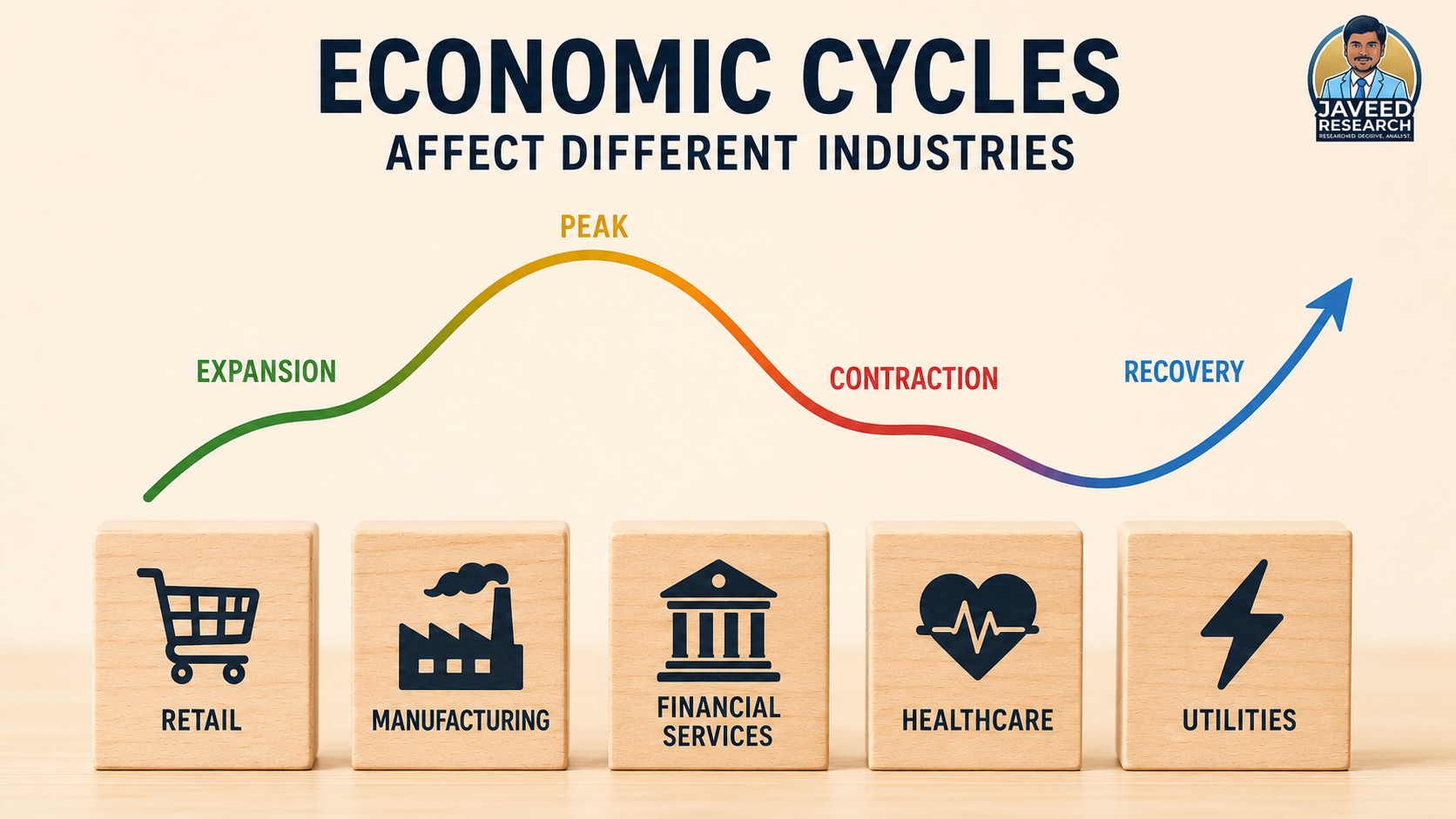
The four commonly discussed stages are:
Expansion: Economic activity increases, businesses grow, employment improves, and consumer spending generally rises.
Peak: Growth reaches a high point and may begin to slow. Inflation and interest-rate pressures can become more noticeable.
Contraction: Economic activity weakens. Businesses may reduce spending, consumers become cautious, and unemployment can rise.
Recovery: Conditions begin improving again, creating the foundation for another period of expansion.
These phases are not perfectly predictable, and they do not last for fixed periods. That inconvenient little detail is why investing is not as simple as memorising a chart and becoming rich by Friday.
Why Different Industries React Differently
Every industry depends on different economic forces.
A luxury car company depends heavily on consumer confidence and disposable income. A utility company provides electricity regardless of whether the economy is booming or slowing. A bank is affected by interest rates, credit demand, and loan quality.
Because the drivers are different, each sector responds differently to changes in the economy.
This is why investors often study sector rotation, where market interest shifts from one group of industries to another as economic conditions change.
Consumer Discretionary Industries
Consumer discretionary companies sell products and services that people usually want rather than absolutely need.
Examples include:
- Automobiles
- Travel and tourism
- Hotels
- Entertainment
- Luxury products
- Restaurants
- Consumer electronics
These industries often perform better during periods of economic expansion.
When employment is strong and people feel financially confident, they may be more willing to buy a new car, take a holiday, upgrade a smartphone, or spend on entertainment.
During an economic slowdown, however, discretionary spending is often one of the first things households reduce.
A family may postpone buying a new television. A holiday may be cancelled. A premium product may suddenly look much less essential.
As a result, these companies can be more sensitive to economic cycles.
Consumer Staples
Consumer staples include products that people continue buying regardless of economic conditions.
Examples include:
- Food
- Household products
- Personal-care products
- Basic beverages
- Essential daily-use goods
People may reduce restaurant visits during a recession, but they still need groceries.
Because demand for essential products tends to remain relatively stable, consumer staples are often considered more defensive than discretionary sectors.
This does not mean these companies cannot fall in value. No sector comes with magical immunity. It simply means their businesses may be less dependent on strong economic growth.
Banking and Financial Services
The financial sector is strongly connected to the health of the economy.
Banks can benefit when businesses borrow to expand and consumers take loans for homes, vehicles, and other purchases.
During periods of healthy economic growth, loan demand may increase and credit conditions may remain strong.
However, financial companies can face challenges during economic contractions.
Businesses may struggle to repay loans. Consumers may default. Credit growth may slow. Asset quality can deteriorate.
Interest rates also play an important role.
Higher rates may improve lending margins in some circumstances, but very high rates can reduce borrowing demand and increase repayment pressure.
This makes banking one of the sectors where economic growth, inflation, interest rates, and credit quality all interact.
Real Estate
Real estate is especially sensitive to interest rates and financing conditions.
When borrowing costs are lower and incomes are growing, demand for housing and commercial property may improve.
During expansionary periods, developers may launch new projects and property transactions may rise.
When interest rates increase sharply, however, home loans become more expensive.
This can reduce affordability and slow demand.
Economic weakness can also hurt commercial property if businesses delay expansion or reduce office and retail space.
Real estate therefore tends to respond not only to the economic cycle but also to monetary policy.
Technology
Technology companies can react differently depending on their business models.
Established technology companies with strong cash flows may behave differently from smaller, fast-growing companies that depend heavily on future earnings.
During periods of low interest rates and strong investor optimism, growth-oriented technology companies may receive higher valuations.
When interest rates rise, investors may become less willing to pay extremely high prices for profits expected many years in the future.
At the same time, technology spending can sometimes remain strong because businesses continue investing in automation, cloud services, cybersecurity, and digital infrastructure.
So treating all technology companies as one identical group can be misleading. Humans love neat categories. Businesses rarely cooperate.
Infrastructure and Capital Goods
Infrastructure, engineering, construction, and capital-goods companies are often linked to investment activity.
During economic expansion, companies may build factories, governments may increase infrastructure spending, and businesses may invest in new machinery.
This can create opportunities for companies involved in:
- Construction
- Engineering
- Industrial equipment
- Roads and transportation
- Power infrastructure
- Manufacturing equipment
However, large projects can be delayed when economic confidence weakens.
These industries can therefore be cyclical and dependent on government policy, corporate spending, and financing conditions.
Automobile Industry
The automobile sector is usually sensitive to economic conditions.
Buying a car or commercial vehicle is a major financial decision for many consumers and businesses.
During periods of rising incomes, strong credit availability, and lower financing costs, vehicle demand may increase.
During a slowdown, consumers may postpone purchases.
Commercial vehicle demand can also reflect broader economic activity because transportation requirements often increase when manufacturing, construction, and trade are growing.
For this reason, the automobile industry can sometimes provide clues about changing economic momentum.
Energy and Commodities
Energy and commodity industries are influenced by both domestic and global economic conditions.
When economic activity increases, demand for oil, metals, and industrial materials may rise.
This can benefit producers when commodity prices strengthen.
During global slowdowns, demand may weaken and prices can fall.
However, commodity prices are also affected by supply disruptions, geopolitical events, production decisions, and weather conditions.
So economic cycles matter, but they are only part of the story.
Healthcare
Healthcare is generally considered a more defensive sector because medical needs do not disappear during economic slowdowns.
People still require:
- Medicines
- Hospital treatment
- Diagnostic services
- Medical devices
- Essential healthcare
This can make demand more stable compared with highly cyclical sectors.
However, individual healthcare companies still face risks related to regulation, competition, pricing, research success, and business execution.
A defensive industry does not automatically make every company within it a good investment.
Utilities
Utilities provide essential services such as electricity, gas, and water.
Demand for these services is generally more stable across economic cycles.
Because of this, utilities are often considered defensive.
However, they can still be influenced by:
- Interest rates
- Regulation
- Fuel costs
- Capital expenditure
- Government policy
Investors should therefore avoid confusing stability of demand with absence of risk.
What Happens During an Economic Expansion?
During expansion, investors may pay more attention to sectors that benefit from stronger spending and business activity.
These can include:
- Financial services
- Consumer discretionary
- Automobiles
- Industrials
- Real estate
- Infrastructure
Corporate earnings may improve as demand rises.
However, late in an expansion, inflation and rising interest rates can create new risks.
A sector that performed well during the early stages of growth may not necessarily continue performing indefinitely.
What Happens During an Economic Slowdown?
During a slowdown, investors often become more cautious.
Attention may shift toward businesses with relatively stable demand and stronger balance sheets.
Defensive sectors such as consumer staples, healthcare, and utilities may receive more interest.
But market behaviour is never perfectly predictable.
Markets often begin reacting before economic data officially confirms a recovery or recession.
That is why investing based only on headlines such as “the economy is growing” or “a slowdown has started” can be dangerous. By the time the news feels obvious, the market may already be looking ahead.
Economic Cycles and Stock Market Cycles Are Not the Same
This is one of the most important concepts for investors to understand.
The economy and the stock market are connected, but they do not move in perfect synchronization.
Stock prices are influenced by expectations about the future.
A market may begin rising while current economic data still looks weak because investors expect conditions to improve.
Similarly, stocks can begin falling while economic numbers still appear strong if investors expect future growth to slow.
The market often tries to price tomorrow before the economy finishes reporting yesterday.
Should Investors Change Sectors Based on Economic Cycles?
Understanding cycles can be useful, but constantly moving money from one sector to another is not automatically a successful strategy.
Sector rotation requires getting several things right:
- Identifying the current economic phase
- Predicting the next phase
- Choosing the right industries
- Selecting financially strong companies
- Buying at reasonable valuations
- Managing risk
Getting even one of these wrong can affect returns.
Instead of blindly chasing whichever industry is currently popular, investors should study the complete picture.
This includes:
- Business fundamentals
- Earnings growth
- Debt
- Valuation
- Industry conditions
- Economic risks
- Investment time horizon
Final Thoughts
Economic cycles influence almost every industry, but they do not affect every business in the same way.
Consumer discretionary companies may benefit from strong spending. Banks can respond to credit and interest-rate conditions. Real estate is affected by financing costs. Healthcare and consumer staples may experience more stable demand during slowdowns.
Understanding these relationships can help investors interpret market movements more clearly.
However, economic cycles should be treated as one part of investment research, not as a shortcut for predicting stock prices.
Successful investing requires studying businesses, managing risk, understanding valuations, and making decisions based on research rather than market excitement or fear.
For investors looking for research-backed market insights and professional guidance, visit Javeed Research and explore insights from a SEBI-registered research analyst before making investment decisions.