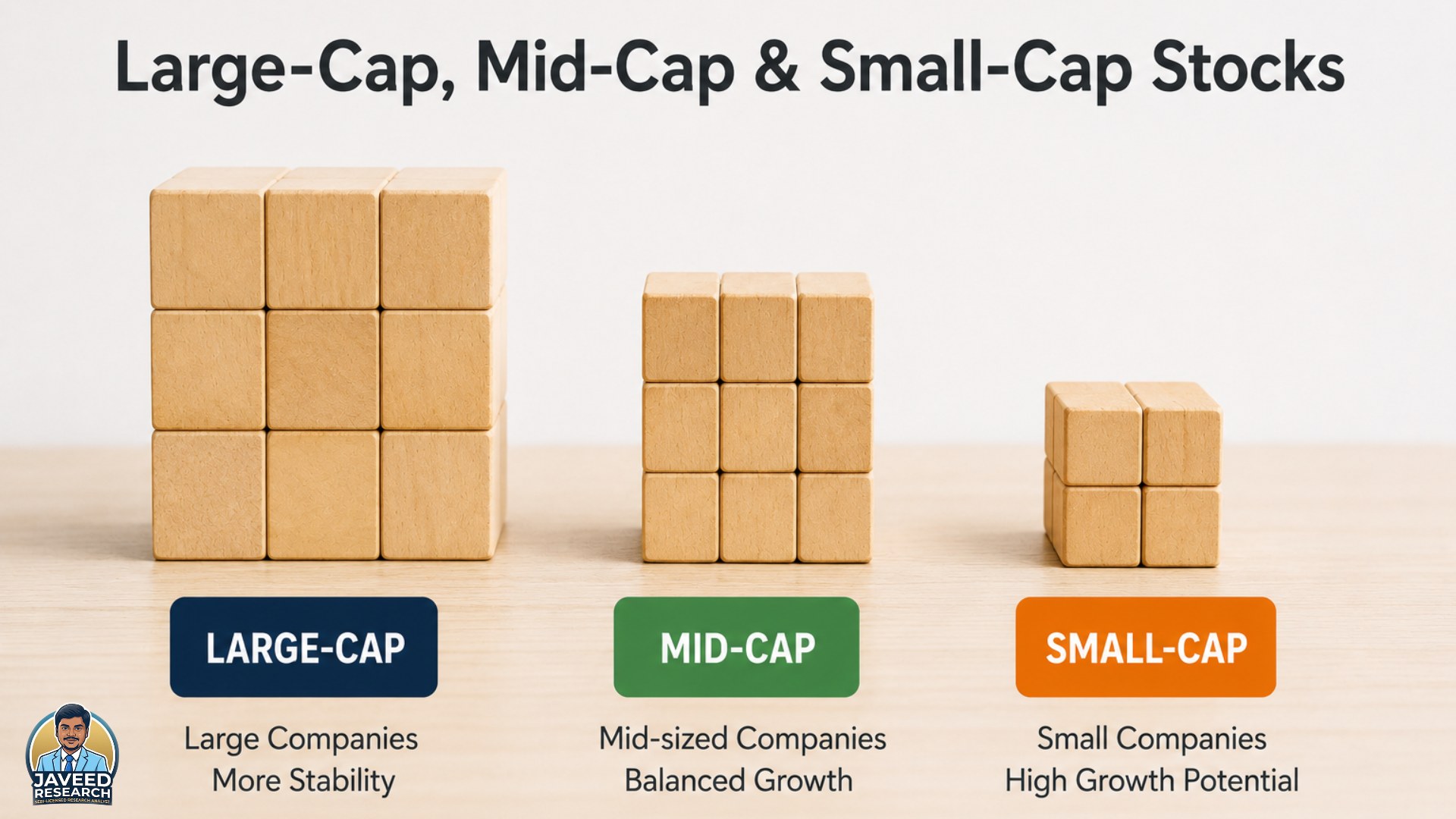
The stock market offers thousands of investment opportunities, but not every listed company is the same size. One of the easiest ways to classify companies is by their market capitalisation (market cap). Understanding the difference between large-cap, mid-cap, and small-cap stocks can help investors build a portfolio that matches their financial goals and risk tolerance.
Whether you are a beginner or an experienced investor, knowing how these categories work is essential before making any investment decisions.
What Is Market Capitalisation?
Market capitalisation is the total market value of a company’s outstanding shares. It helps investors understand the size of a company.
Formula
Market Capitalisation = Share Price × Total Outstanding Shares
For example:
- Share Price = ₹500
- Total Outstanding Shares = 10 Crore
Market Capitalisation = ₹5,000 Crore
A company’s market capitalisation changes every day because its share price fluctuates in the stock market.
How Are Stocks Classified?
Companies listed on the stock exchange are generally divided into three categories based on their market capitalisation ranking.
| Category | Company Ranking |
| Large-cap | Top 100 companies |
| Mid-Cap | 101 to 250 |
| Small-Cap | 251 onwards |
As companies grow or decline in value, they may move from one category to another over time.
What Are Large-Cap Stocks?
Large-cap stocks belong to the biggest and most established companies in the market. These businesses usually have a long operating history, stable earnings, and strong brand recognition.
Advantages
- Stable business performance
- Lower investment risk
- High liquidity
- Consistent financial growth
- Better ability to handle economic downturns
Disadvantages
- Slower growth compared to smaller companies
- Limited scope for extraordinary returns
Large-cap stocks are generally suitable for investors looking for long-term stability and consistent returns.
What Are Mid-Cap Stocks?
Mid-cap companies are businesses that have already established themselves but still have significant room for growth. Many successful large-cap companies were once mid-cap stocks.
Advantages
- Good balance between risk and return
- Higher growth potential than large-cap stocks
- Better expansion opportunities
Disadvantages
- More volatile than large-cap stocks
- Earnings may fluctuate during economic uncertainty
Mid-cap stocks are suitable for investors who want higher returns while accepting moderate risk.
What Are Small-Cap Stocks?
Small-cap companies are relatively smaller businesses with the potential for rapid expansion. These companies may operate in emerging industries or niche markets.
Advantages
- High growth potential
- Opportunity for significant long-term returns
- Potential to become future market leaders
Disadvantages
- Higher volatility
- Greater business risk
- Lower liquidity
- More sensitive to market fluctuations
Small-cap stocks require patience, proper research, and a long-term investment approach.
Comparison Between Large-Cap, Mid-Cap, and Small-Cap Stocks
| Feature | Large-Cap | Mid-Cap | Small-Cap |
| Company Size | Large | Medium | Small |
| Investment Risk | Low | Moderate | High |
| Return Potential | Moderate | High | Very High |
| Volatility | Low | Medium | High |
| Liquidity | High | Good | Lower |
| Suitable For | Conservative Investors | Balanced Investors | Aggressive Investors |
Which Category Should You Choose?
There is no single category that is best for every investor. Your decision should depend on your financial goals, investment horizon, and risk tolerance.
Choose Large-Cap Stocks If:
- You prefer stable investments.
- You are a beginner in the stock market.
- You want lower volatility.
- You are investing for long-term wealth preservation.
Choose Mid-Cap Stocks If:
- You want a balance between growth and stability.
- You are comfortable with moderate market fluctuations.
- You have a medium to long-term investment horizon.
Choose Small-Cap Stocks If:
- You are willing to take higher risks.
- You are investing for long-term capital appreciation.
- You understand business analysis.
- You can tolerate market volatility.
Should You Invest in All Three?
A diversified portfolio often includes a combination of large-cap, mid-cap, and small-cap stocks.
Diversification helps investors:
- Reduce overall portfolio risk
- Improve long-term return potential
- Balance stability with growth
- Manage market volatility more effectively
Instead of concentrating all investments in one category, spreading investments across different market-cap segments can provide better risk-adjusted returns.
Common Mistakes Investors Make
Investing Only in Small-Cap Stocks
Many investors are attracted by the possibility of high returns. However, small-cap stocks can also experience significant declines during market corrections.
Ignoring Large-Cap Stocks
Some investors believe large-cap companies no longer offer attractive returns. In reality, they often provide stability during uncertain market conditions.
Buying Stocks Without Research
Market capitalisation only indicates the size of a company. It does not tell you whether the business is financially strong.
Before investing, always analyse:
- Revenue growth
- Profitability
- Debt levels
- Business model
- Management quality
- Future growth prospects
Why Market Capitalisation Matters
Understanding market capitalisation helps investors:
- Build a balanced portfolio
- Match investments with financial goals
- Understand investment risk
- Compare companies more effectively
- Make informed investment decisions
Choosing stocks based solely on popularity or recent price movements can be risky. A well-informed investment strategy considers both company size and business fundamentals.
Final Thoughts
Large-cap, mid-cap, and small-cap stocks each play a different role in an investment portfolio.
- Large-cap stocks offer stability and consistent performance.
- Mid-cap stocks provide a balance between growth and risk.
- Small-cap stocks have the potential for higher returns but come with greater volatility.
There is no perfect category for every investor. The right choice depends on your financial goals, investment timeline, and ability to manage risk. A diversified portfolio backed by proper research is often the smartest approach for long-term wealth creation.